On August 15th, a branch of Germany's
NPD extreme-right party (often
referred to as "nazi") organized a demonstration in the
Nordrhein-Westfallen city of Münster as part of a tour through the state
in advance of the upcoming regional and national elections.
The NPD allegedly has strong focus in this region in cities like Dortmund, Hamm, and Unna.
Münster,
unlike my former city of Dresden, Saxony, is a rather inhospitable place for
extreme right politics. The city is very international, tolerant, and
highly protective of its standard of living and multi-faceted local
culture. Possibly one of the aspects of why the NPD has not been able to
make headway in Münster can be attributed to the local, regional, and
national governments being involved, to various degrees (even if in
disagreement) with the city. The governments appear to, in contrast to
Dresden, not shield itself from the community. In fact, one can
sometimes see the mayor and various staff at local events, among
crowds. The criticism in the former East Germany is the apathy the
governments have, from the local level straight up to the national
level. The people there feel slighted, as the NPD is there year-round,
while other, "legitimate" politicans often only make their presence
known in relation to elections. There is effectively little resistance
from within in Eastern Germany and why the few residents who protest need to import protesters.
Largely,
a media-statistics game is played in Dresden (home of Europe's largest yearly
neo-nazi rally), which directly conflicts with video and other materials
that are posted online. They constantly reduce the number of
alleged nazis
that appear, inflating the number of demonstrators against them, and
claim the marches are blocked, while, in fact, they simply go through
different streets. The local governments try to give the impression
that the alleged nazis are all imports, when many are the very people of
Dresden and the surrounding towns, such as Bischoffswerda and Hoyerswerda, where
swastikas and neonazis are seen quite often. The media also plays a
statistics game with the voting numbers, acting as if xenophobia and
nazism doesn't exist on a daily basis due to voting trends. Both are
prevalent and problematic, but the people decouple their voting habits
from their personal politics.
Münster contrasted itself
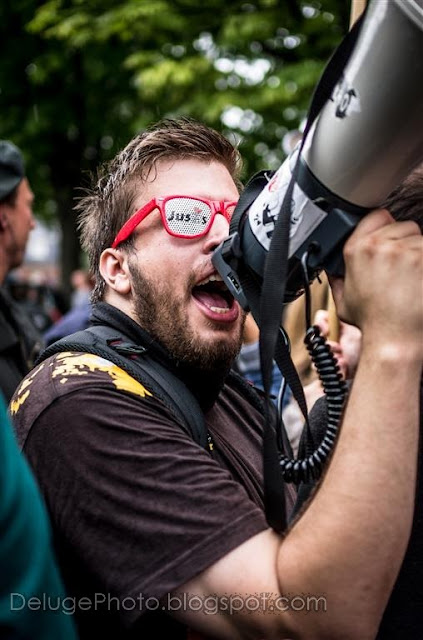
and proved itself as actively against them. The demonstrators
assembled first at the Stadthaus and walked, in solidarity, to
Schlossplatz to peacefully counter the NPD speech with noise and direct addresses. Their leader,
Holger Apfel
had zero chance and gave up after only a few minutes. Again, this
contrasts with Dresden. Effectively, the crowd trolled the NPD for
several hours, then not allowing the 7-8 members to not leave the city.
The frustration of the NPD became evident, as the crowd continued to
peacefully heckle them, surrounding them completely and progressively enclosing them in a small space.
The turnout was mixed, including
large numbers of elderly interspersed within a crowd of very young.
Often, some of the most vocal were the older members of the protests,
again, contrasted with Dresden. The estimate I've seen is 1,500 for the
turnout, which I believe to be somewhat underestimated.
Also
contrasted with Dresden was the peaceful, respectful police presence.
The police in Dresden are often accused to being supporters of the NPD
as they march alongside them. However, the police in Münster, even with
alternating formations often used to break sympathetic connections
between them and the people, to some degree, blended with the
protesters. There was no violence that I saw, and anti-police animosity
(and signage) was mostly gone when many saw the police were not overtly
sympathetic towards the NPD. If anything, they
proved neutrality and respect for the demonstrators and the city. Later
pictures in the series will reveal the good nature of some officers and how they
correctly handled the actual mood and attitudes of the protesters, not
using some classroom flowchart of how to deal with all protesters, which can often
ignite tensions. My positive opinion of the police might not be shared by any side, but, in contrast to what I've seen in East Germany, I will happily defend their professionalism. Other aspects I will not discuss in specifics, but it felt apparent that the police were not interested in the NPD coming to the city.




_tn.png)


_tn.jpg)


